

Who's in Scope with LyteNyte Grid PRO
Determining Developer Coverage
RoarLyte - 17 May 2025 (7min)

Unfortunately, enterprise-grade data grid libraries often come with enterprise-grade licensing terms, meaning clarity is rarely part of the package.
Determining who needs to be covered by a commercial data grid library license can raise more questions than bad API documentation. Does it include all developers working on a project? Does using a wrapper library change the calculation? And of course, the question that stops everyone cold: Do I need to license everyone in my repository?
At 1771 Technologies, we understand that front-end development isn’t always neatly compartmentalized. Teams share code, contributors shift between roles, and the data grid you’re using might be several abstraction layers away from the person writing the logic. In that environment, vague license terms slow you down and leave teams guessing who’s actually “in scope.”
That’s why LyteNyte Grid PRO licensing is built around a clear, developer-based model: All you have to consider is who’s active in the front-end code.
This blog walks through exactly how to determine which developers need to be covered using practical examples. No guesswork. Just clarity.
- Check out our FAQ. Learn more about LyteNyte Grid license plans.
- LyteNyte Grid redistribution. Learn more about LyteNyte Grid PRO distribution and deployment.
Determining Who Needs a LyteNyte Grid License
In a nutshell, the number of developers covered by your license must equal the number of concurrent developers who write, modify, or contribute to the front-end codebase of any project that uses or integrates LyteNyte Grid or its derivative works.
At any given time, any developer actively contributing to the front-end code must be licensed, whether interacting directly with LyteNyte Grid, accessing it indirectly through intermediate layers or wrappers, or focusing on other parts of the project’s front-end code. The license requirement is based on the number of developers concurrently active in the front-end code, not the total number who have ever contributed.
Developers who perform both front-end and back-end coding tasks must also be licensed.
A license is not required for roles that do not write, modify, or contribute changes to the front-end codebase, such as UX/UI designers who work exclusively in design platforms like Figma.
To make developer licensing even clearer, we will break it down piece by piece, like deconstructing a LEGO set, with a few examples to clarify everything.
Illustration One: Merlin Securities LLC
Merlin Securities LLC is developing AppX, a portfolio dashboard for stock data. AppX will include financial charts, custom views, and a lightning-fast React data grid powered by LyteNyte Grid.
Merlin Securities has assigned 9 employees to work on AppX. Of these, 4 developers actively contribute to the front-end codebase, where LyteNyte Grid is integrated. This group includes developers working directly with LyteNyte Grid, those contributing to other areas of the front-end code, and a full-stack developer who splits time between front-end and back-end tasks.
Under LyteNyte Grid’s licensing model, all 4 developers must be licensed because they are writing, modifying, or contributing to the front-end code of a project that uses LyteNyte Grid, regardless of whether they touch LyteNyte Grid directly or work elsewhere in the front-end codebase.
The remaining five employees are back-end developers, a UX/UI designer, and a QA tester. Since their work does not involve writing or modifying the front-end codebase, they do not require a LyteNyte Grid license.
Note
QA testers typically do not require a LyteNyte Grid license unless their role involves contributing code to the front-end.
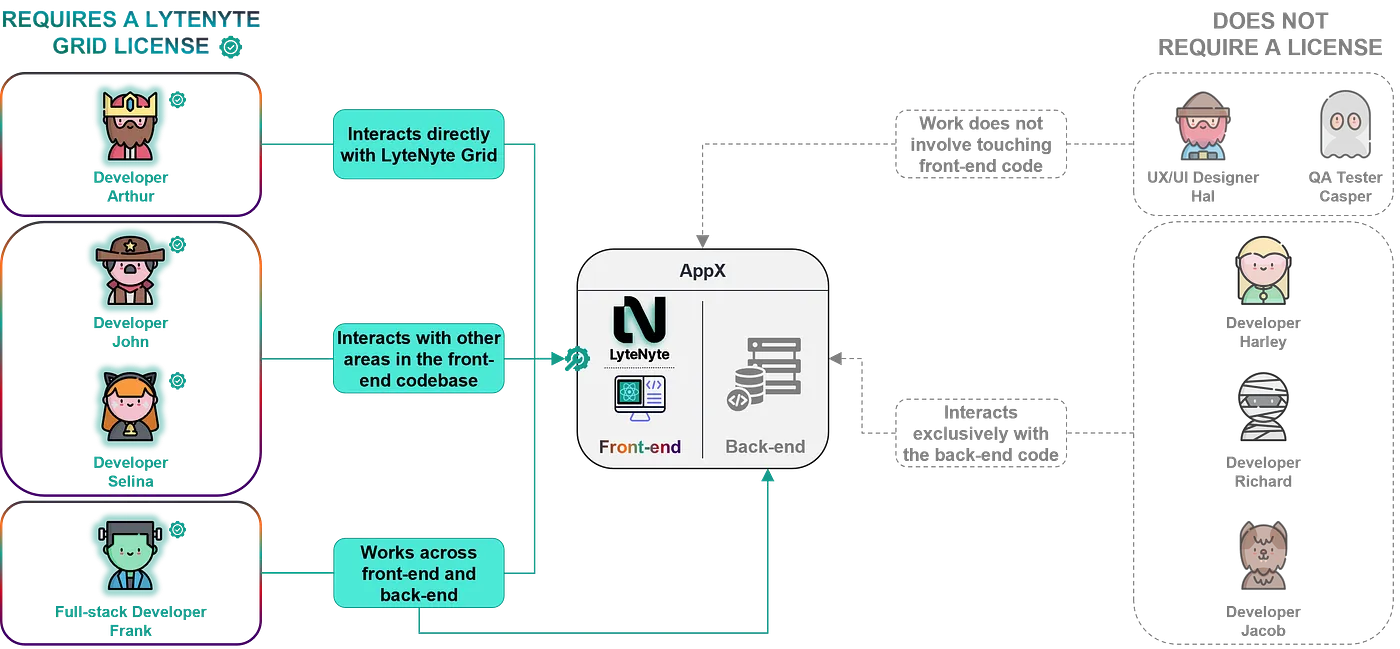
Illustration Two: Wayne Industrial Inc.
Wayne Industrial Inc. is developing Bats-UI, an internal UI component library that integrates LyteNyte Grid and other proprietary components. The Bats-UI team consists of 3 developers contributing to its front-end code, while a UX/UI designer assists the project without writing code.
Bats-UI is integrated into AppZ, a cybersecurity dashboard maintained by a different engineering team of 5 developers. Of those, 2 developers contribute to the AppZ’s front-end code, which uses Bats-UI and therefore LyteNyte Grid, while the remaining 3 developers work exclusively on the back-end code.
Under LyteNyte Grid’s licensing model, developers who contribute to the front-end code of any project that uses LyteNyte Grid, whether directly or via a wrapper like Bats-UI, must be licensed.
As a result, Wayne Industrial is required to license 5 developers:
- 3 working on the Bats-UI front-end.
- 2 working on the AppZ front-end.
Team members who do not contribute to the front-end code, such as back-end developers and designers, do not require a license.
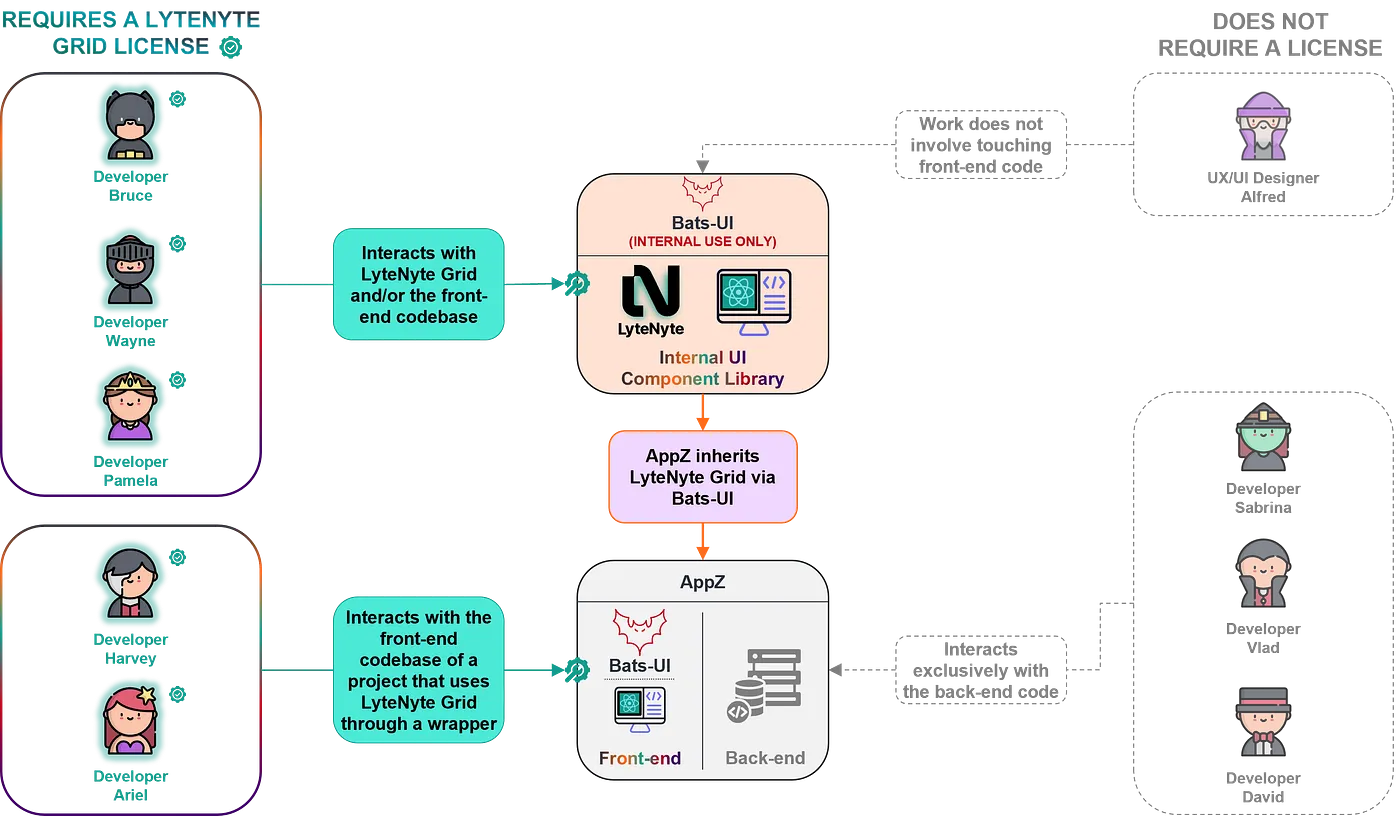
Illustration Three: Oscorp EdTech Inc.
Oscorp EdTech Inc. is developing NxO Grid, an internal derivative of LyteNyte Grid with customized features. A team of 2 developers contributes to its front-end code and interacts directly with LyteNyte Grid.
NxO Grid is integrated into Goblin-UI, an internal UI component library maintained by a separate team of 2 developers. These developers directly contribute to Goblin-UI’s front-end code, indirectly using LyteNyte Grid through its derivative, NxO Grid. Additionally, 2 UX/UI designers support both projects without writing code.
Goblin-UI is integrated into App-Spectra, a learning analytics dashboard built by another team of 4 developers. Of these, 2 developers contribute to App-Spectra’s front-end code, indirectly using LyteNyte Grid via Goblin-UI and NxO Grid. The remaining 2 developers work exclusively on the back-end code without interaction with the front-end codebase.
Under LyteNyte Grid’s licensing model, any developer contributing to the front-end code of a project using LyteNyte Grid or its derivatives must be licensed, even if the grid is accessed indirectly through internal libraries or wrappers.
Therefore, Oscorp EdTech Inc. must license 6 developers:
- 2 working on the NxO Grid front-end.
- 2 working on the Goblin-UI front-end.
- 2 working on the App-Spectra front-end.
Back-end-only developers and non-coding contributors like UX/UI designers do not require a license.
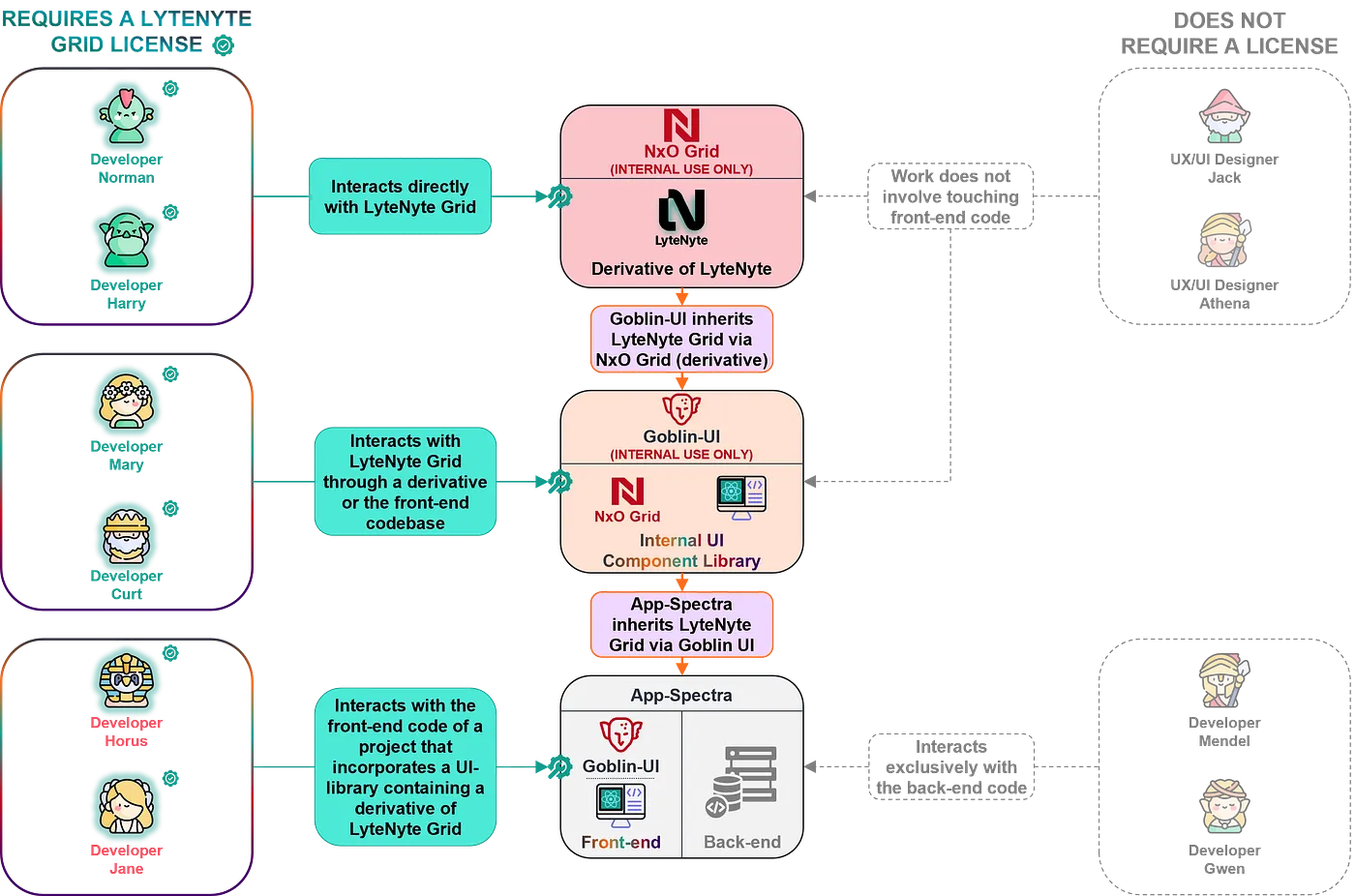
Illustration 4: Stark Enterprises Ltd.
Stark Logistics Ltd. is developing 3 internal applications to modernize its business operations.
- App-Infinity: A dashboard to view all business transactions and customer payments.
- App-Arc: An analytics platform that displays real-time shipment records and global delivery logs.
- App-M3: A routing dashboard designed to assist couriers during last-mile delivery.
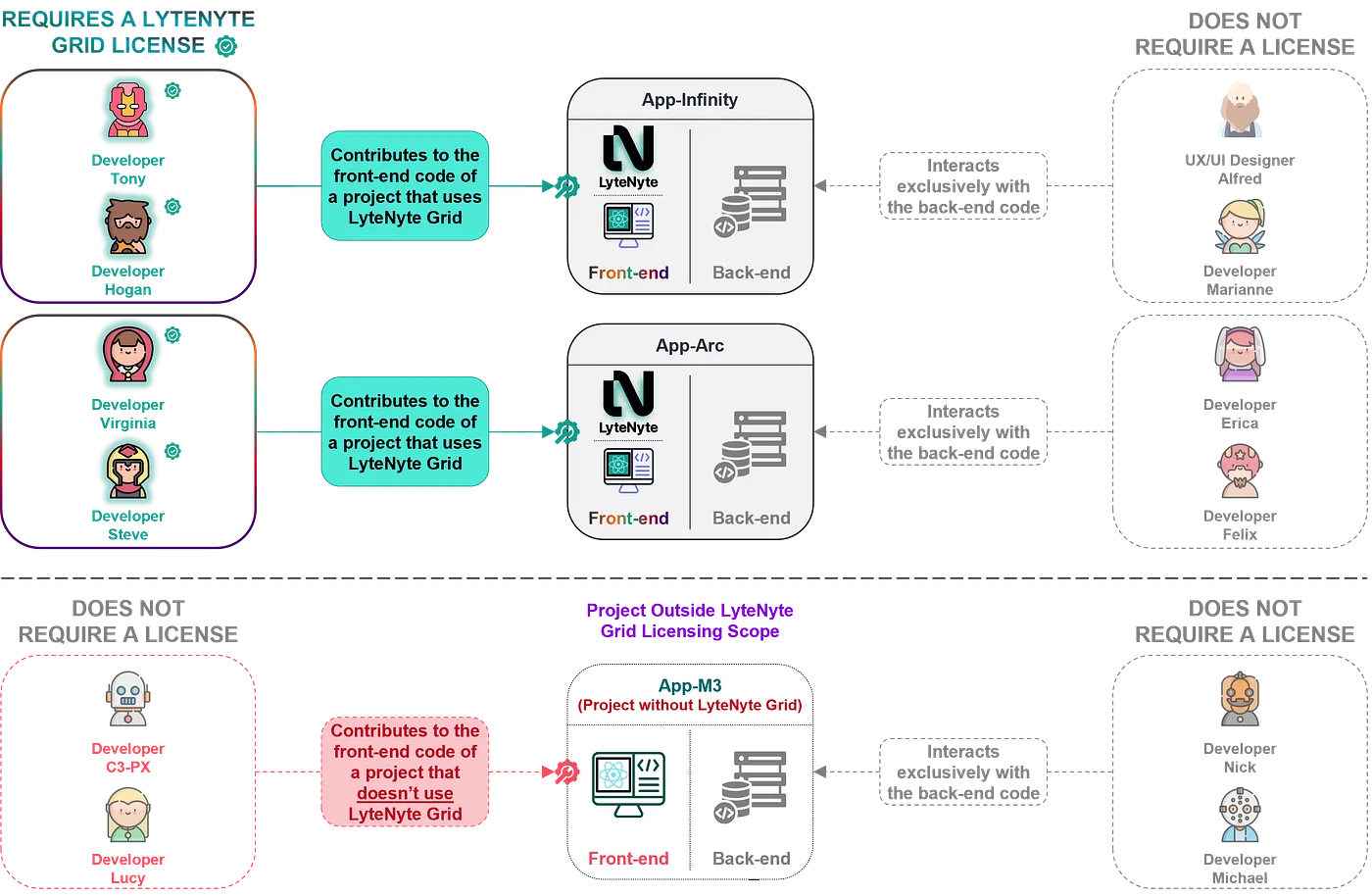
LyteNyte Grid will be integrated into App-Infinity and App-Arc. App-M3 does not integrate LyteNyte Grid and is being developed in-house with the team’s proprietary tools.
Each application is being developed by a separate engineering team assigned by Stark Logistics. Each team consists of 2 developers contributing to the front-end code and 2 working solely on the back-end.
There are no restrictions on how many applications you can build with LyteNyte Grid PRO. Under the LyteNyte Grid licensing model, a company only needs to determine the number of developers contributing to the front-end code of applications that use LyteNyte Grid or its derivatives. That’s all there is to it.
Since App-M3 doesn’t use LyteNyte Grid, directly or indirectly, none of its developers require a license. However, because App-Infinity and App Arc integrate LyteNyte Grid, all developers contributing to those applications’ front-end code must be licensed.
As a result, Stark Logistics must license 4 developers:
- 2 working on App-Infinity front-end.
- 2 working on App-Arc front-end.
Concurrency & License Transferability
In real-world engineering teams, developers frequently switch between projects. People leave, join, or shift roles, and a LyteNyte Grid PRO plan is built to accommodate that. Our licenses are not associated with specific developers and can be reassigned internally as your team changes over time.
The key requirement is that at any given time, the number of developers contributing to the front-end code of a project that includes LyteNyte Grid doesn’t exceed the number of licensed seats on your plan. This is what we mean by ‘concurrent developers’.
You stay compliant as long as the number of front-end contributors working on the project simultaneously does not exceed your seat count. Internal reassignments are allowed because the model is built for flexibility, as long as you remain within your licensed total. If you need to increase your licensed developer count, you can do so at any time through the client portal.
Licenses cannot be transferred outside your organization. Reassignment is permitted only within the same legal entity (or one you directly control). This ensures the license is used only by your organization, on your team’s projects, as originally intended.
License Clarity, Scope Confirmed
Not knowing how to determine the number of developers your license needs to cover isn’t just a legal risk; it’s lost time, internal confusion, and hesitation to ship. After walking through the examples, you have a clear and actionable roadmap for identifying who’s in scope and how to stay compliant.
But the benefit goes beyond compliance. Knowing precisely who needs to be licensed gives your team the confidence to adapt, shift, and scale without second-guessing. A LyteNyte Grid PRO plan removes the friction of uncertainty, giving your organization a predictable, future-proof runway as your team evolves.
Get Started Now
- Try the interactive demo. See LyteNyte Grid PRO in action.
- Compare license plans. Choose the right fit for your team.
Or start building with the free LyteNyte Grid Core edition. It’s open source, memory efficient, and ready to drop into your next React project.