

Understanding LyteNyte Grid PRO Redistribution
React Data Grid Licensing Decoded
RoarLyte - 17 May 2025 (6min)

Most commercial license plans raise more questions than they answer. Vague terminology, inconsistent definitions, and a lack of real-world examples make compliance more complicated than it should be. The result? Procurement delays, frustrated engineering teams, and an endless cycle of guesswork, email chains, and legal uncertainty.
At 1771 Technologies, we designed the LyteNyte Grid PRO licensing plan to eliminate ambiguity and make compliance straightforward.
You don’t need to worry about how many applications you can build, what counts as a deployment, or where or how your software is hosted. One license covers on-premises installations, SaaS offerings, or cloud-hosted applications. You can build across as many projects, applications, servers, and domains as you need. No legal fog. No fine print. Just a licensing model built to turn complexity into clarity. If your application is external-facing, there are a few additional restrictions to keep in mind, but they’re clearly defined and easy to follow.
- Check out our FAQ. Learn more about LyteNyte Grid license plans
Understanding Distribution and Deployment
LyteNyte Grid PRO license plans grant you a perpetual, royalty-free right to use and install the software across any hosting environment. Whether your application runs on internal servers (on-premises), in the cloud, or is shipped as a SaaS product, the license terms stay the same. There are no added fees tied to your infrastructure or hosting model.
What matters is not how or where you host your application; it’s who uses it and what rights they are given.
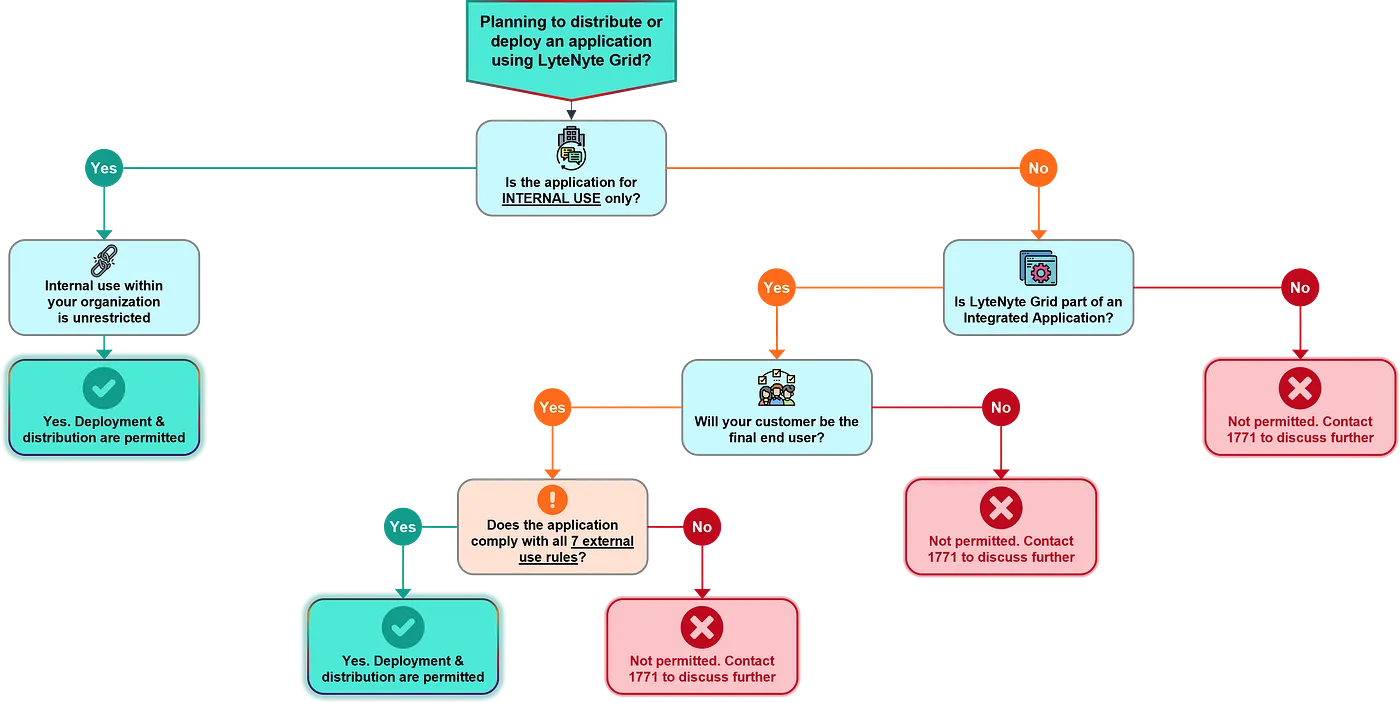
If your application is used exclusively within your organization, such as by employees, contractors, or entities under your direct control, it qualifies as internal use. In that case, you have complete flexibility to integrate LyteNyte Grid however you need.
If it’s made available to users outside your organization, such as customers, clients, or partners, it’s considered external use, and additional restrictions on distribution and deployment apply. That distinction is critical to understanding your LyteNyte Grid PRO license.
LyteNyte Grid: Internal Freedom and External Responsibility
Once you understand the difference between internal and external use, applying our licensing model becomes straightforward.
Internal use provides complete flexibility. You’re free to distribute, deploy, integrate, and customize LyteNyte Grid however you need, whether in dashboards, admin panels, internal libraries, reusable components, or internal development toolkits. There are no functional restrictions, as long as you stay within your licensed developer count.
External use is permitted, but with clearly defined boundaries. You can distribute or deploy applications externally, but only under specific conditions designed to preserve the integrity of the licensing model. External use requires LyteNyte Grid to be part of an integrated application and not be exposed for reuse, sublicensing, or developer-facing functionality by third parties.
An integrated application is a complete, functional application that includes LyteNyte Grid as a component of a larger feature set and is intended for end use by your customers.
In a nutshell, internal use means full control; for external use, different rules apply.
What External Use Can’t Include
When you distribute or deploy externally, the guiding principle is simple: LyteNyte Grid must always be part of a complete, integrated application used by your end customers, not something they use to build with. If your application turns the grid into a development tool, a reusable resource, or a launching point for someone else’s software, that is outside the license scope.
The 7 Restrictions for External Use
Here’s what you cannot do under a LyteNyte Grid PRO license:
- Don’t offer it as a standalone product. LyteNyte Grid can’t be sold, distributed, or deployed as a standalone product. It must always be embedded within a larger, fully integrated application.
- Don’t expose it for reuse. You may not ship LyteNyte Grid or its parts as a shared module, component, wrapper, package, or any way that allows it to be reused across projects or accessed by other applications, libraries, or developer environments.
- Don’t build something that competes with it. You can’t create derivative products, components, libraries, or wrappers that compete with or substantially replicate the functionality of LyteNyte Grid PRO.
- Don’t use it in developer tools or to create them. That includes toolkits, application or website builders, low-code platforms, drag-and-drop editors, admin generators, or any application intended for use by software, application, or website developers or designers.
- Don’t share the source code. You can’t distribute or deploy LyteNyte Grid in source code form or make it available in any form that allows others to modify, extend, or reverse-engineer it.
- Don’t open-source it. LyteNyte Grid can’t be incorporated into any project with licenses requiring source disclosure, allowing derivative works, or permitting free redistribution.
- Don’t sublicense it. Your license doesn’t transfer to your customers, partners, or downstream users. They must obtain their own license if they need development access.
These restrictions apply no matter how your software is delivered. SaaS, on-prem, downloadable packages, and hosted services are all subject to the same rules. Packaging, bundling, or obfuscation does not reduce or eliminate your licensing obligations.
Build for users, not for builders. That single distinction defines the boundary.
- Read the EULA. For the full licensing terms.
Your Responsibility as the License Holder
Everything covered, from integrated applications to external use, rests on a straightforward principle: your organization holds the license rights.
When you license LyteNyte Grid PRO, those rights apply solely to your organization and licensed developers. They are non-transferable and cannot be sublicensed or extended to customers, clients, or downstream users.
If you distribute or deploy an external application that includes LyteNyte Grid, you’re responsible for ensuring it can’t be extracted, reused, or turned into a development tool by end users. That obligation doesn’t shift downstream. It stays with you.
Here’s what that looks like in practice:
- End users must not be able to access or modify LyteNyte Grid as a module, configurable component, or anything else that can be built on.
- You cannot grant downstream users any rights to the grid, regardless of how the software is bundled or compiled.
- Your product should include terms of use that reflect the license limitations, specifically prohibiting reuse, redistribution, sublicensing, and development access.
- If your end users want to build with LyteNyte Grid, they must obtain their own license from 1771 Technologies.
Licensing LyteNyte Grid is simple. Staying compliant is too, and it works because you make it work.
Clear Terms. Confident Shipping
You don’t need to decipher overly complicated license terms. If you’re building for internal users, LyteNyte Grid gives you full freedom. If you’re deploying externally, just keep it part of a complete, integrated application and not a tool others can build with.
That’s it.
We designed the LyteNyte Grid PRO license to eliminate the guesswork that frustrates many teams. No vague terms. No per-deployment fees. No convoluted exceptions buried in legalese. You get clarity, flexibility, and peace of mind, whether building dashboards for your operations team or deploying a production-grade SaaS platform.
If you’re tired of decoding license plans and just want to focus on shipping software, LyteNyte Grid PRO is made for you.
Get Started Now
- Try the interactive demo. See LyteNyte Grid PRO in action.
- Compare license plans. Choose the right fit for your team.
Or start building with the free LyteNyte Grid Core edition. It’s open source, memory efficient, and ready to drop into your next React project.